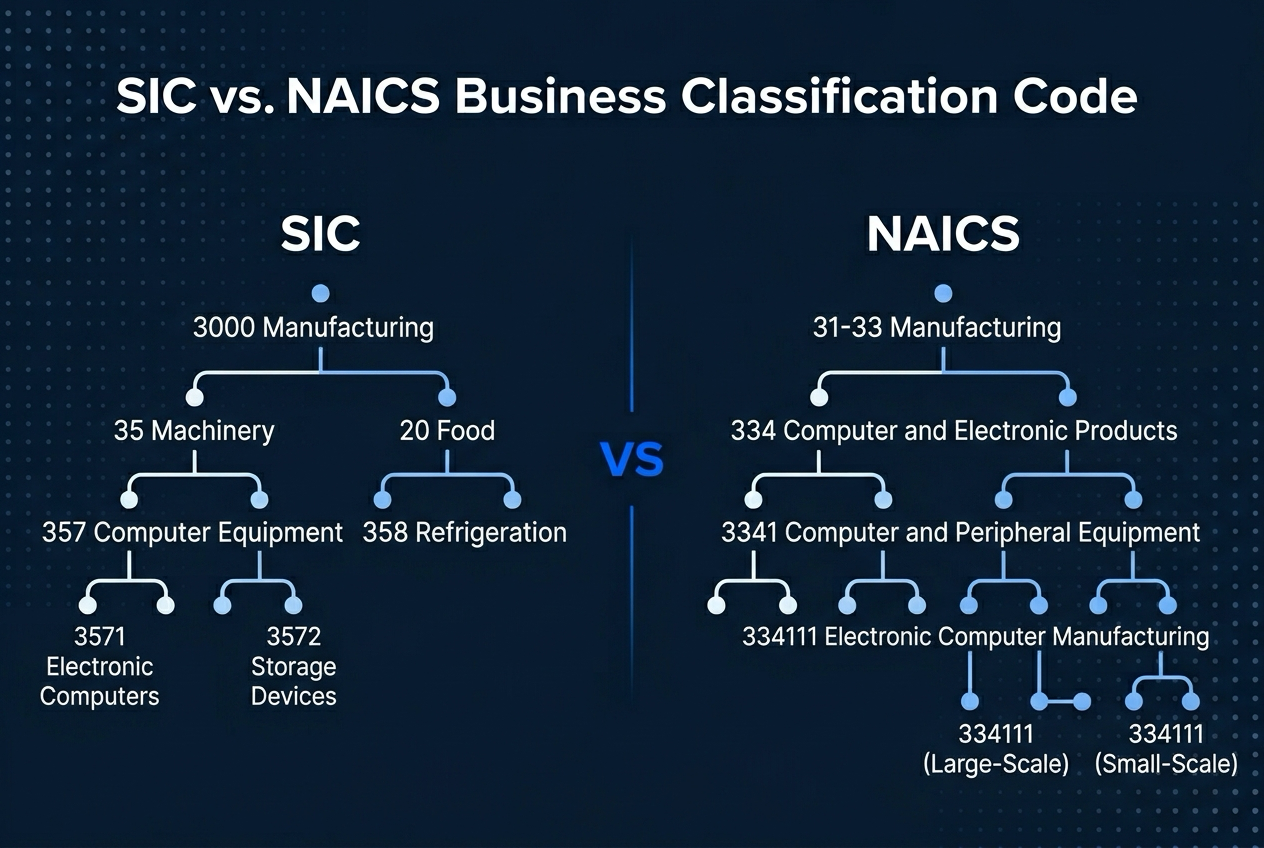

A SIC code is a four-digit number that classifies a company by its primary economic activity, used across regulatory filings, commercial databases, and B2B marketing platforms. The system was replaced for U.S. federal statistics in 1997 by NAICS codes — see What is a NAICS code? for the companion guide, or our SIC vs NAICS comparison for the side-by-side. SIC codes share a lineage with the European NACE codes used across the EU. To browse SIC codes by industry, our directory covers every division and 4-digit code; if you need company records that already carry both classifications, our firmographic data ships SIC and NAICS attached on every record.
TL;DR
- A SIC code (Standard Industrial Classification code) is a 4-digit number that identifies a company's primary economic activity — not the company itself.
- The SIC hierarchy has four levels: Division → Major Group (2 digits) → Industry Group (3 digits) → Industry (4 digits).
- A company's primary SIC code reflects its dominant business activity; it can also carry up to five secondary codes for additional activities.
- SIC codes are used for SEC filings, B2B prospecting, KYB compliance, government contracting, and market research.
- The U.S. officially replaced SIC with NAICS in 1997, but SIC persists in financial regulation, commercial databases, and UK company registrations.
- You can find your SIC code via the OSHA manual, SEC EDGAR, Companies House (UK), or a commercial data provider.
This guide covers the full picture: what SIC codes are (and what they are not), how the system is structured, how to read and interpret a code, how primary codes are assigned to multi-activity businesses, and why SIC codes are still relevant despite being officially superseded in the United States nearly 30 years ago.
What a SIC Code Is — and What It Is Not
A SIC code — Standard Industrial Classification code — is a four-digit number that classifies a business based on its primary economic activity. It answers one question: what industry does this company operate in?
What a SIC code is not:
- It is not a unique company identifier. Thousands of companies share the same SIC code. It describes an industry, not a specific business.
- It is not a tax identification number or business registration number. Having a SIC code does not constitute formal registration with any authority.
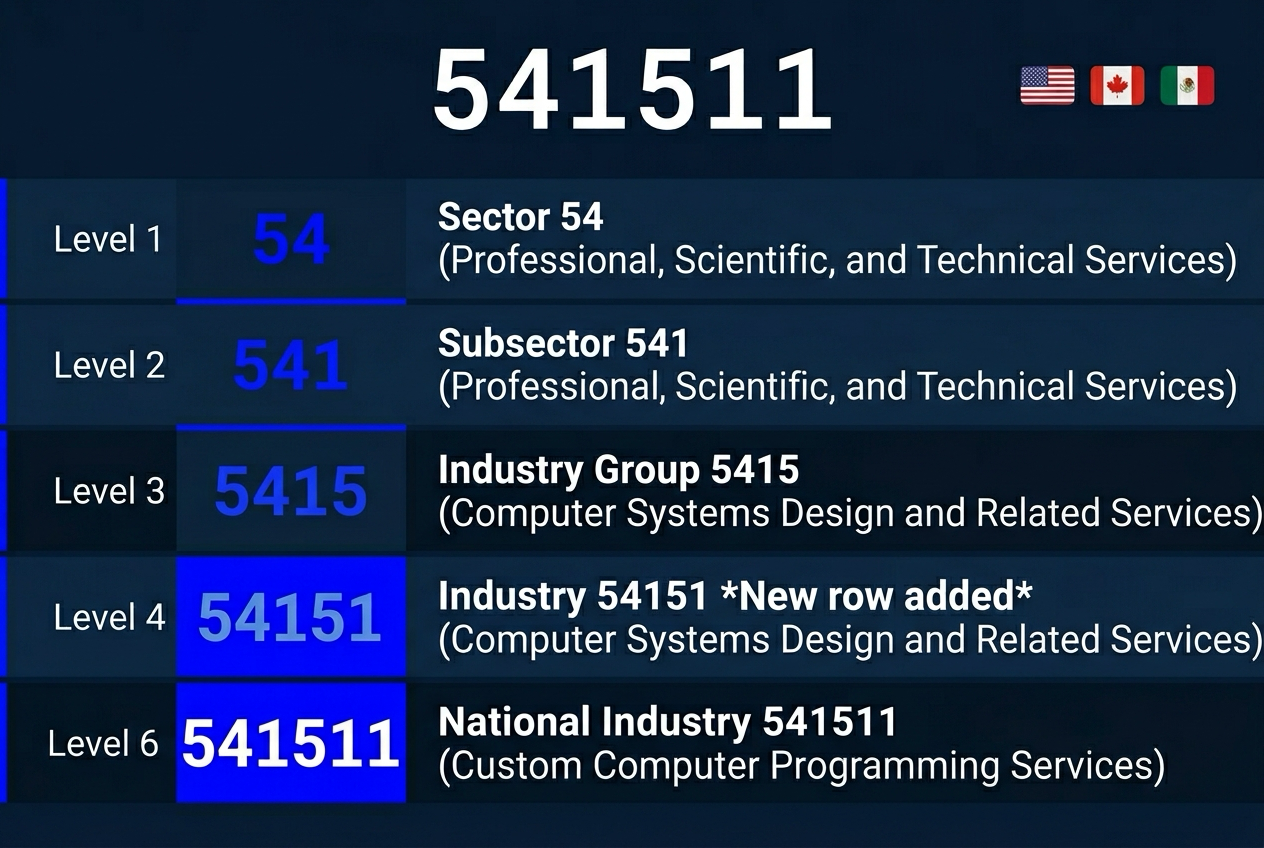
- It is not the same as a NAICS code. NAICS (North American Industry Classification System) replaced SIC for U.S. federal statistics in 1997. The two systems cover similar territory but use different structures and code ranges.
- It is not a European NACE code. NACE codes are the EU's equivalent classification system. While SIC and NACE share structural similarities, they are separate standards maintained by different bodies.
Understanding what a SIC code does not do is just as important as knowing what it does. It is a classification label — a way of grouping companies into comparable industry buckets — not an identifier, credential, or registration.
SIC Structure: From Division to 4-Digit Code
The SIC system is hierarchical. Every four-digit code sits within a nested structure of four levels, each providing a progressively finer view of a company's industry.
The four levels
Level 1 — Division The broadest grouping. The SIC system divides the entire economy into 11 major divisions, each covering a numeric range of codes.
| Division | Code Range | Industry Area |
|---|---|---|
| A | 0100–0999 | Agriculture, Forestry, Fishing |
| B | 1000–1499 | Mining |
| C | 1500–1799 | Construction |
| D | 2000–3999 | Manufacturing |
| E | 4000–4999 | Transportation, Communications, Utilities |
| F | 5000–5199 | Wholesale Trade |
| G | 5200–5999 | Retail Trade |
| H | 6000–6799 | Finance, Insurance, Real Estate |
| I | 7000–8999 | Services |
| J | 9100–9729 | Public Administration |
| K | 9900–9999 | Nonclassifiable Establishments |
Division
A
Code Range
0100–0999
Industry Area
Agriculture, Forestry, Fishing
Division
B
Code Range
1000–1499
Industry Area
Mining
Division
C
Code Range
1500–1799
Industry Area
Construction
Division
D
Code Range
2000–3999
Industry Area
Manufacturing
Division
E
Code Range
4000–4999
Industry Area
Transportation, Communications, Utilities
Division
F
Code Range
5000–5199
Industry Area
Wholesale Trade
Division
G
Code Range
5200–5999
Industry Area
Retail Trade
Division
H
Code Range
6000–6799
Industry Area
Finance, Insurance, Real Estate
Division
I
Code Range
7000–8999
Industry Area
Services
Division
J
Code Range
9100–9729
Industry Area
Public Administration
Division
K
Code Range
9900–9999
Industry Area
Nonclassifiable Establishments
Level 2 — Major Group (first 2 digits) Within each division, companies are grouped into major industry groups identified by the first two digits of the SIC code. Within Division D (Manufacturing), for example, major group 35 covers Industrial and Commercial Machinery and Computer Equipment.
Level 3 — Industry Group (first 3 digits) The first three digits narrow the classification further. Within major group 35, code 357 covers Computer and Office Equipment specifically.
Level 4 — Industry (all 4 digits) The full four-digit code identifies a specific industry. Code 3571 is Electronic Computers.
This structure means you can start from the division level and drill all the way down to a precise industry — or work backwards from a four-digit code to understand the broader sector it belongs to.
How to Read a SIC Code
Each digit in a SIC code carries specific meaning within the hierarchy. Here is how to read two common examples.
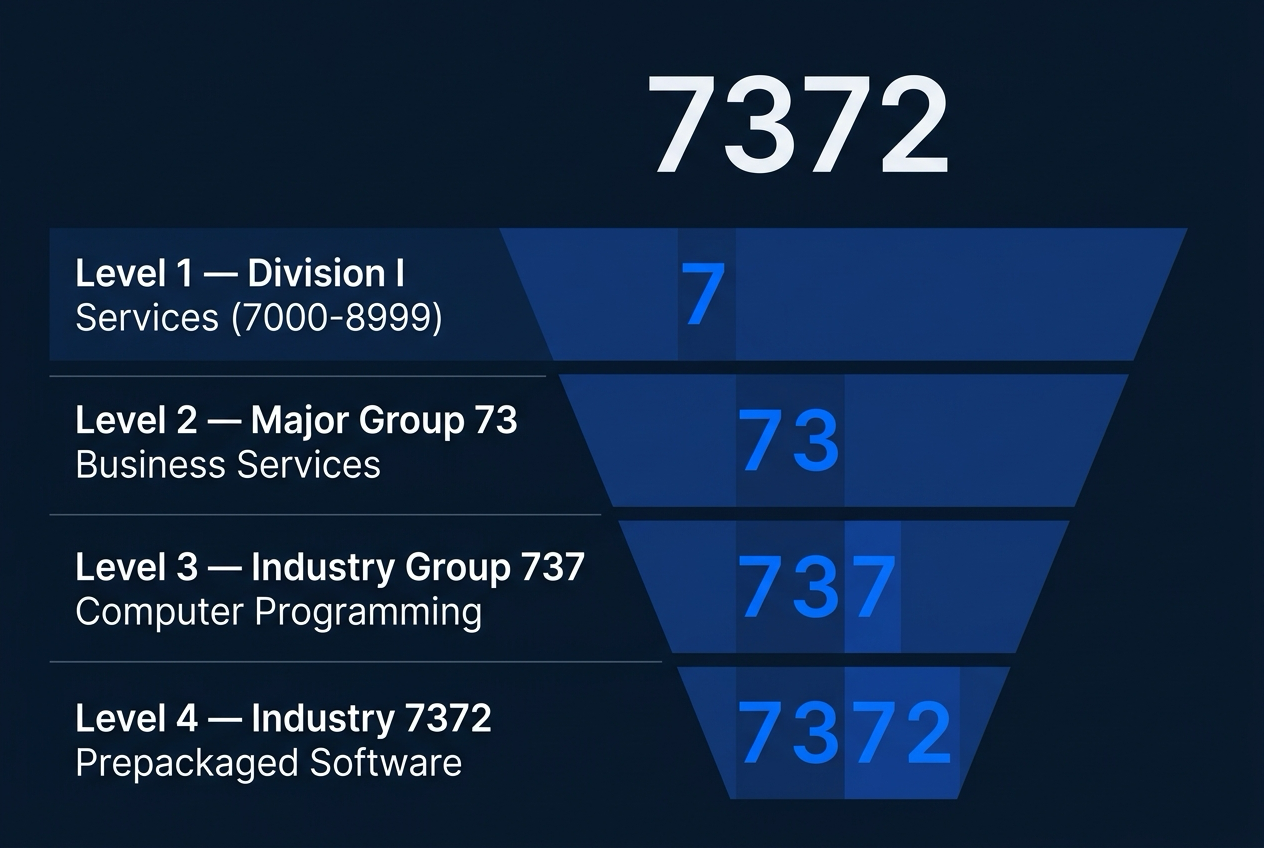
Example 1: SIC code 7372
| Digits | Level | Meaning |
|---|---|---|
| 7 | Division | Division I — Services (7000–8999) |
| 73 | Major Group | Business Services |
| 737 | Industry Group | Computer Programming, Data Processing |
| 7372 | Industry | Prepackaged Software |
Digits
7
Level
Division
Meaning
Division I — Services (7000–8999)
Digits
73
Level
Major Group
Meaning
Business Services
Digits
737
Level
Industry Group
Meaning
Computer Programming, Data Processing
Digits
7372
Level
Industry
Meaning
Prepackaged Software
Example 2: SIC code 6411
| Digits | Level | Meaning |
|---|---|---|
| 6 | Division | Division H — Finance, Insurance, Real Estate (6000–6799) |
| 64 | Major Group | Insurance Agents, Brokers, and Services |
| 641 | Industry Group | Insurance Agents, Brokers, and Services |
| 6411 | Industry | Insurance Agents, Brokers, and Services |
Digits
6
Level
Division
Meaning
Division H — Finance, Insurance, Real Estate (6000–6799)
Digits
64
Level
Major Group
Meaning
Insurance Agents, Brokers, and Services
Digits
641
Level
Industry Group
Meaning
Insurance Agents, Brokers, and Services
Digits
6411
Level
Industry
Meaning
Insurance Agents, Brokers, and Services
The practical takeaway: even without a reference guide, the first digit of a SIC code gives you a reliable signal about the broad sector a company operates in. Codes starting with 2–3 are manufacturing; 5 is trade; 6 is finance; 7–8 is services.
What Is an Example of a SIC Code?
Here are real examples across a range of common industries:
| SIC Code | Industry Description |
|---|---|
| 3571 | Electronic Computers (Manufacturing) |
| 5411 | Grocery Stores (Retail) |
| 6022 | State Commercial Banks — Federal Reserve Members |
| 6531 | Real Estate Dealers and Brokers |
| 7311 | Advertising Agencies |
| 7372 | Prepackaged Software |
| 8062 | General Medical and Surgical Hospitals |
| 8111 | Legal Services |
| 8721 | Accounting, Auditing, and Bookkeeping Services |
| 4213 | Trucking, Except Local |
SIC Code
3571
Industry Description
Electronic Computers (Manufacturing)
SIC Code
5411
Industry Description
Grocery Stores (Retail)
SIC Code
6022
Industry Description
State Commercial Banks — Federal Reserve Members
SIC Code
6531
Industry Description
Real Estate Dealers and Brokers
SIC Code
7311
Industry Description
Advertising Agencies
SIC Code
7372
Industry Description
Prepackaged Software
SIC Code
8062
Industry Description
General Medical and Surgical Hospitals
SIC Code
8111
Industry Description
Legal Services
SIC Code
8721
Industry Description
Accounting, Auditing, and Bookkeeping Services
SIC Code
4213
Industry Description
Trucking, Except Local
Every company in the "Advertising Agencies" bucket shares code 7311, regardless of their size, revenue, or country of operation. SIC codes group by activity, not by company characteristics.
Primary SIC Code and Dominant Activity
Most companies do more than one thing. A manufacturing firm might have an in-house distribution arm. A consulting company might also sell proprietary software. When a business spans multiple activities, which SIC code applies?
The dominant activity rule
A company's primary SIC code should reflect the activity that accounts for the largest share of its output — typically measured by revenue, though employment and value added are also used. If the same company generates 70% of its revenue from software sales and 30% from consulting, SIC code 7372 (Prepackaged Software) is the more appropriate primary code.
Primary and secondary codes
In the U.S. SIC framework:
- A company holds one primary SIC code — the code that best describes its principal business activity.
- It can carry up to five secondary SIC codes for additional activities, even if those activities are unrelated to the primary one.
Secondary codes are used in commercial databases and B2B platforms to capture companies that operate across sectors. A logistics company with a secondary code in warehousing, for instance, will appear in searches for both trucking and storage.
Who assigns primary SIC codes?
There is no single, centralised authority for private companies:
- SEC-registered companies self-report a SIC code in their filings, and the SEC assigns or confirms it based on the primary activity described.
- UK companies provide a SIC code at incorporation through Companies House, selecting the code that best describes their main activity.
- Commercial data providers derive or verify SIC codes by cross-referencing revenue data, company descriptions, and official filings — and may update them as a company's activity evolves.
When a business changes its primary activity — through growth, acquisition, or strategic pivot — the primary SIC code should be updated to reflect the new reality.
What Is a SIC Code Used For?
SIC codes serve a wider range of purposes than most people working with them realise.
SEC filings and financial reporting
The U.S. Securities and Exchange Commission uses SIC codes to classify every publicly traded company on EDGAR — its electronic filing database. Financial analysts, compliance officers, and investors use SIC codes to filter companies by sector, benchmark performance, and screen for industry-specific regulatory requirements. This is one of the main reasons SIC codes remain in active use in the United States despite the NAICS transition.
B2B marketing and prospecting
For sales and marketing teams, SIC codes are one of the most reliable filters for building industry-targeted prospect lists. Rather than defining target industries from scratch, teams can:
- Filter company databases by SIC code to pull all businesses in a given sector
- Build account-based marketing (ABM) audiences segmented by industry
- Identify competitors in the same SIC category
- Append SIC codes to existing CRM records for richer segmentation
The specificity of the four-digit hierarchy means that a software company targeting mid-size accounting firms (SIC 8721) can isolate that segment precisely, rather than sorting through all professional services firms.
Government contracting and licensing
Federal and state agencies use SIC codes in procurement databases and licensing applications. Although NAICS has become the federal standard for most statistical and contracting purposes, SIC codes still surface in older procurement systems and some state-level agency workflows.
KYB and compliance
Know Your Business (KYB) programs use SIC codes to assess industry risk during business onboarding. Compliance teams cross-reference a company's declared SIC code against registry data to validate that the stated activity matches actual business operations. Industries with higher inherent risk — such as money services, gambling, or cash-intensive retail — carry SIC codes that may trigger enhanced due diligence requirements automatically.
Market research and competitive intelligence
Researchers and analysts use SIC codes to group companies for benchmarking, size estimation, and trend analysis. Because SIC codes appear consistently across decades of business data, they provide a stable reference point for comparing industries over time — even when the companies themselves have changed significantly.
SIC History and Continuity Value
The 1937 origins
The Standard Industrial Classification system was created by the U.S. government in 1937. Federal agencies at the time each maintained their own industry definitions, making cross-department comparisons nearly impossible. A shared classification framework — one four-digit code per industry — gave statisticians and administrators a common vocabulary for economic reporting.
The system was revised periodically, most significantly in 1972 and 1987. The United Kingdom introduced its own parallel SIC system in 1948, which has since been revised in 1992 and 2007 to align with the European NACE Rev. 2 standard.
Why NAICS didn't erase SIC
In 1997, the U.S. officially adopted NAICS as the replacement for SIC across federal statistical agencies. NAICS offered better coverage of the modern service economy, a consistent standard across the U.S., Canada, and Mexico, and a more regular revision cycle. For a detailed comparison of how the two systems differ, see our guide: SIC vs NAICS: Key Differences, History, and How to Use Both.
Despite this, SIC did not disappear. Three factors explain its staying power:
1. The SEC never migrated. EDGAR still classifies public companies by SIC code. With tens of thousands of publicly traded companies and decades of filings, the financial world remains anchored to SIC in a way that NAICS has not disrupted.
2. Commercial databases were built on SIC. Decades of B2B data — company records, industry directories, CRM imports — were structured around SIC codes. The cost of migrating all that data to NAICS has led most providers to carry both systems in parallel, preserving SIC as a usable field.
3. Extended SIC codes added private-sector value. Private data companies developed extended 6- and 8-digit SIC codes that provide more granularity than the original 4-digit system. These extensions allow highly specific sub-industry classification that even NAICS does not match — keeping extended SIC relevant for detailed B2B targeting.
How to Find or Get Your Company's SIC Code
U.S. companies
OSHA SIC Manual: The Occupational Safety and Health Administration maintains a searchable SIC index — one of the most accessible starting points for U.S. companies. Search by keyword or browse by division to find the closest matching code.
SEC EDGAR: If your company is publicly traded or has registered with the SEC, your SIC code appears in the header of your filings. Search by company name and look for the "SIC" field.
State business registries: Some U.S. states include SIC codes in business registration records. Coverage varies by state, but it is worth checking your state's registry if you need to confirm an assigned code.
Commercial data providers: B2B data platforms — including InfobelPRO — include SIC codes in verified company records, derived from government filings, registries, and industry self-reporting. This is often the fastest path to finding SIC codes for large batches of target companies.
UK companies
UK companies are required to provide at least one SIC code at the point of incorporation with Companies House. The ONS publishes the UK SIC manual, and Companies House provides a code lookup tool for businesses filing their annual confirmation statement. UK SIC codes use a five-digit format that differs from the U.S. four-digit system, though the underlying sector structure is broadly comparable.
Mapping SIC to NACE for European markets
If your prospecting or compliance work spans both North American and European markets, you will need to translate between SIC codes and NACE codes. The InfobelPRO NACE/SIC code converter maps between the two systems, letting you find equivalent industry codes across markets without manual cross-referencing. For the US system, the SIC to NAICS conversion table covers 941 of the 1,004 four-digit SIC industries, mapped at the five-digit NAICS industry level.
SIC vs NAICS: Which One Applies to You?
The practical answer is: it depends on context — and often both apply at once.
- Publicly traded U.S. company: Your SEC filings use a SIC code. SIC is directly relevant regardless of NAICS.
- Registering for U.S. federal contracts: You need a NAICS code via SAM.gov. SIC is not used here.
- Working with B2B company databases: You will likely encounter both. Most major data providers carry both codes per company record.
- UK company: Your SIC code is assigned by Companies House. NAICS does not apply.
- European company: NACE codes are the relevant system, though SIC codes can be mapped across using a converter.
For a full comparison of how SIC and NAICS differ in structure, history, sector coverage, and day-to-day use, see: SIC vs NAICS: Key Differences, History, and How to Use Both.